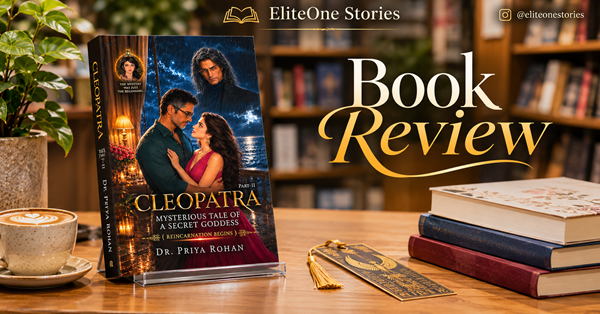
Some mysteries are never truly buried in the past. They continue to live through memories, unanswered questions, ancient beliefs, and the possibility that human existence holds secrets beyond our understanding. Dr. Priya Rohan’s Cleopatra: Mysterious Tale of a Secret Goddess, Part II – Reincarnation Begins explores this fascinating idea through a story that brings together mythology, romance, spirituality, reincarnation, and psychological suspense. Rather than presenting Cleopatra simply as a historical figure, the author opens the door to a much larger mystery, inviting readers to imagine what might exist beyond the boundaries of time, identity, and consciousness.
The novel Cleopatra: Mysterious Tale of a Secret Goddess, Part II – Reincarnation Begins begins with an intriguing question: what if Cleopatra’s story did not end with her death? This simple yet powerful thought forms the foundation of a narrative that connects the ancient world with modern life. At the centre of the story is Devi, a young girl growing up in rural India. Although her surroundings appear ordinary, there is something unusual about her personality. Her calm nature, emotional maturity, and mysterious inner world suggest that there may be more to her existence than meets the eye. Her character creates a sense of curiosity and encourages readers to explore the deeper meaning behind her journey.
One of the most interesting aspects of the book is its connection between ancient Egyptian history and Indian spiritual philosophy. These two worlds, separated by geography and centuries, come together through the concept of reincarnation. The author explores the possibility that memories, emotions, and relationships may continue beyond a single lifetime. This idea gives the novel a distinctive identity and makes it appealing to readers who enjoy stories that challenge conventional ways of thinking.
The emotional dimension of the story is equally important. Love, attraction, obsession, and possession become significant elements of the narrative. The book explores how powerful emotions can influence human behaviour and how the boundaries between love and obsession can sometimes become dangerously unclear. This psychological element adds depth to the central mystery. Instead of treating romance merely as a beautiful experience, the novel also considers its darker and more complicated possibilities. It raises questions about attachment, desire, emotional vulnerability, and the nature of human relationships.
The inclusion of archaeological discoveries adds another interesting layer to the story. While the spiritual aspects encourage readers to consider possibilities beyond scientific explanation, archaeology brings an element of investigation and discovery. The idea of researchers encountering phenomena that cannot easily be explained through established historical knowledge creates an engaging contrast between rational thinking and supernatural possibilities. It is this meeting of history, science, mythology, and spirituality that makes the premise particularly compelling.
Dr. Priya Rohan’s professional background makes her approach to the subject especially interesting. As a Neurointegrative Mental Health Specialist, Mental Health Researcher, and Integrative Medicine Doctor, she brings a multidisciplinary perspective to her literary work. Her fascination with the human mind and consciousness is reflected in the themes of the novel. Questions surrounding identity, memory, perception, and emotional experiences are closely connected to the central mystery. Her interests in psychology, spirituality, and creative expression give the book a thoughtful foundation that extends beyond conventional supernatural fiction.
Another appealing quality of the novel is its willingness to explore questions without limiting them to straightforward answers. Who are we beyond our present identities? Can certain emotional connections survive across lifetimes? Is consciousness limited to our physical existence, or could it be something much greater? These questions have fascinated people for generations, and the novel uses fiction as a means of exploring them. Readers do not necessarily need to believe in reincarnation or supernatural experiences to appreciate the imaginative possibilities presented here.
The title, Reincarnation Begins, also carries an interesting sense of anticipation. As the second instalment in the Cleopatra series, the book suggests that the mystery surrounding the ancient queen is far from complete. It expands the central concept into a wider exploration of existence, divine consciousness, and timeless connections. Readers familiar with the first instalment may find the continuation particularly intriguing, while those interested in historical mysteries and spiritual fiction may discover an unusual literary experience.
The novel’s ambitious combination of genres may especially appeal to readers who enjoy stories that offer more than simple entertainment. Its spiritual and philosophical themes invite reflection, while the elements of romance and psychological suspense provide emotional tension. Readers who prefer straightforward historical fiction may find its supernatural approach unconventional, but that very quality gives the book its individuality. It is a work of imaginative fiction that encourages curiosity rather than claiming to provide definitive historical or scientific answers.
Overall, Cleopatra: Mysterious Tale of a Secret Goddess, Part II – Reincarnation Begins by Dr. Priya Rohan offers an intriguing exploration of history, human emotions, spirituality, and the mysteries of consciousness. Its central idea encourages readers to look beyond familiar explanations and consider the extraordinary possibilities hidden within human existence. For those who enjoy reincarnation stories, supernatural mysteries, psychological suspense, and emotionally layered narratives, this book deserves a place on their reading list. It leaves readers with a fascinating thought: perhaps some stories never truly end, and some mysteries are simply waiting for another lifetime to unfold.