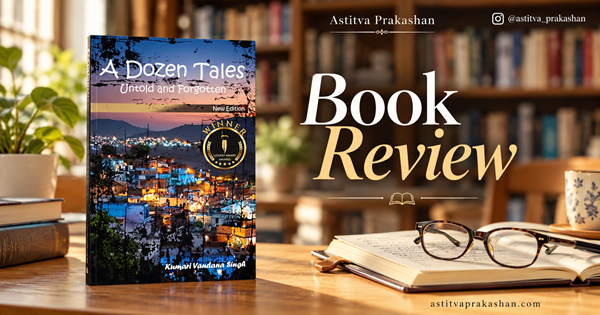
The most meaningful stories are not always those involving extraordinary achievements, dramatic conflicts, or celebrated personalities. Sometimes they emerge from ordinary conversations, unnoticed sacrifices, unfulfilled ambitions, and moments of emotional vulnerability. These experiences rarely attract public attention, yet they reveal important truths about society and human nature. Kumari Vandana Singh’s A Dozen Tales: Untold & Forgotten explores this understanding through twelve short stories that bring overlooked human experiences into the literary foreground. With its emphasis on emotional realities, social concerns, and the relationship between individuals and their surroundings, the collection invites readers to discover significance in lives that might otherwise remain unheard.
The central appeal of the book A Dozen Tales: Untold & Forgotten lies in its commitment to representing human experiences beyond conventional measures of success and recognition. Modern society frequently associates importance with professional achievement, financial prosperity, or public influence. However, countless individuals contribute to their families and communities without receiving acknowledgement. Their struggles may remain invisible because they occur within familiar environments and everyday routines. Singh’s collection challenges readers to recognise that the absence of public recognition does not diminish the emotional depth or significance of an individual’s life.
An important thematic feature of A Dozen Tales: Untold & Forgotten is its exploration of the relationship between rural and urban existence. Villages and cities represent different social environments, each shaped by distinctive expectations and opportunities. Rural communities often preserve strong connections with tradition, family, and collective identity, while urban environments are commonly associated with mobility, ambition, and rapid transformation. Yet neither setting is free from emotional uncertainty or social challenges. By placing these contrasting worlds within one collection, Singh draws attention to the universal concerns that connect people across geographical and cultural divisions.
The book’s focus on ordinary individuals also provides a framework for examining the contradictions of contemporary society. Technological development and economic progress have transformed communication, employment, and access to information, but they have not eliminated prejudice, loneliness, or inequality. People may live surrounded by others while feeling emotionally isolated. Opportunities may appear abundant while remaining inaccessible to those restricted by economic circumstances or social expectations. Literature concerned with these realities encourages readers to look beyond visible progress and consider the experiences of individuals who continue to struggle within changing social structures.
The collection’s attention to women and their experiences is particularly relevant. Across generations, women have frequently encountered expectations that place family obligations above personal ambitions. Although social attitudes continue to evolve, many individuals still navigate complicated relationships between independence, responsibility, tradition, and identity. Fiction exploring these tensions can reveal the emotional consequences of choices shaped by external pressure. Singh’s longstanding interest in gender-related concerns, also reflected in her Hindi poetry, provides an important foundation for this aspect of her literary outlook.
Another significant concern is the emotional world of children. Childhood is often idealised as a period of innocence and carefree discovery, yet it also involves experiences that can shape an individual’s understanding of relationships and society. Feelings of exclusion, uncertainty, affection, loss, and curiosity may leave lasting impressions. By recognising children as individuals with meaningful emotional experiences, the collection’s thematic scope extends beyond adult struggles and acknowledges the importance of early encounters with the world.
Memory and silence provide another compelling way to interpret the book’s literary identity. The title suggests that stories can disappear through two distinct processes. Some remain unspoken because individuals fear judgment, lack opportunities for expression, or believe their experiences are insignificant. Others are gradually forgotten as time passes and attention shifts elsewhere. Both circumstances raise questions about the preservation of personal and collective histories. Through its commitment to overlooked narratives, the collection positions storytelling as an important means of resisting this disappearance.
The choice of twelve short stories supports the book’s exploration of diverse perspectives. Short fiction allows an author to focus on particular situations without requiring the extended development associated with a novel. Each narrative can offer a separate encounter with human emotion while contributing to a larger thematic understanding. For readers, this format provides opportunities to reflect upon individual experiences and consider how different circumstances reveal shared aspects of human nature.
Kumari Vandana Singh’s professional and artistic background adds depth to the collection’s creative context. A business educator by profession, she developed an early interest in poetry, painting, and storytelling while growing up in Uttar Pradesh. Her artistic pursuits reflect a desire to examine the emotional and social dimensions of life through different forms of expression. Her Hindi poetry collections, Kavya Shrinkhala and Kavya Silsila, address subjects including politics, corruption, education, terrorism, gender inequality, childhood, and nature.
This engagement with social issues establishes a meaningful connection between her poetry and English-language fiction. While poetry often communicates through imagery, rhythm, and concentrated emotion, short stories provide opportunities to explore human circumstances through narrative situations. Both forms can encourage readers to question assumptions and consider perspectives beyond their immediate experiences.
Singh’s involvement in painting offers another dimension to her literary identity. Her artistic work includes figurative compositions, landscapes, still life, and abstract painting. This range reflects an interest in observing the world through different perspectives. Her philosophy that life resembles a canvas shaped by experiences and choices corresponds with the collection’s central concern for the individuality of human stories.
The author’s forthcoming poetry compilation, scheduled for 2027, further demonstrates her continuing literary ambitions. Bringing together selections from her earlier collections alongside new compositions, the proposed volume is expected to contain nearly one hundred poems addressing motivation, nature, gender dynamics, and social realities.
Available through Amazon in paperback and eBook editions, as well as international bookselling networks, A Dozen Tales: Untold & Forgotten has the potential to connect with readers across cultural boundaries. Its concerns are particularly relevant to those interested in contemporary Indian literature, human relationships, and socially reflective storytelling.
Ultimately, A Dozen Tales: Untold & Forgotten, the collection offers an invitation to reconsider how we perceive the people around us. Every life contains experiences that cannot be understood through appearances alone. Behind silence may exist disappointment, courage, longing, or hope. Behind ordinary routines may lie extraordinary emotional journeys. Through its emphasis on overlooked voices, Kumari Vandana Singh’s A Dozen Tales: Untold & Forgotten reminds readers that literature can preserve experiences that society might otherwise neglect. Its enduring message is that understanding begins with attention, compassion, and the willingness to recognise humanity in every story.