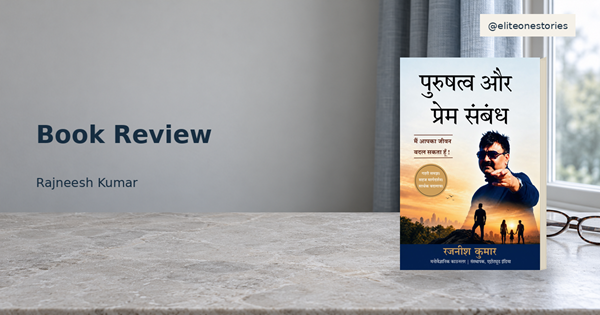
What does a man turn to when the familiar instructions for building a life no longer answer the questions he faces? The supplied description of पुरुषत्व और प्रेम संबंध by Rajneesh Kumar begins with the education many men are expected to acquire: study, earn and be a good son. It then points to another education that may remain incomplete, the ability to understand a partner and make sense of one’s own conduct in a relationship. For EliteOne Stories, the interest of this Hindi title lies in that shift of attention. It presents the private work of understanding relationships as a serious subject, especially for men whose confidence has been unsettled by conflict or loss.
This is a description-based review, drawing on the supplied book synopsis and author biography. No manuscript was available, so observations about the book concern its declared purpose and potential reader relevance, not a verified assessment of its prose, structure or methods. The distinction is important because the subtitle, मैं आपका जीवन बदल सकता हूँ, sets a high expectation of change. A description can introduce such an ambition but cannot demonstrate that the book fulfils it. The discussion below approaches that promise as part of the book’s positioning, while reserving judgement on the substance and effectiveness of the complete work.
The reader imagined by the synopsis is not simply someone seeking a happier romance. He may be deciding whom to build a life with, confronting a marriage under strain or trying to recover his bearings after a relationship has ended. The book is presented as a conversation he should have been offered earlier. That framing gives its subject a personal immediacy: the difficulty is not only what has happened, but the absence of a language for understanding it. As an editorial premise, this is compelling because it treats emotional uncertainty as something that can be discussed seriously rather than hidden behind the performance of competence.
One of the description’s more useful questions concerns the difference between being loved and being controlled. It is a distinction readers may recognise as difficult to make from inside an unhappy relationship. The synopsis offers no case studies or criteria, however, and it would be misleading to infer that the book provides a particular diagnostic framework. Its potential rests instead in opening a careful conversation about expectations and respect. That conversation must remain specific to the people involved. A book addressed to men can examine their experiences without treating women as a single category or encouraging readers to label every disagreement as evidence of bad intent.
The synopsis also asks readers to consider patterns learned in childhood that may recur in adult relationships. This introduces the possibility of self-examination into a premise that could otherwise become focused entirely on choosing the right partner. It raises questions about what a person recognises as familiar, what they assume they must tolerate and how they interpret another person’s behaviour. These are interpretive questions prompted by the description, not claims about exercises or explanations in the unseen manuscript. Their presence nevertheless makes the proposed subject richer: the reader is invited to look at the history they bring with them, as well as the relationship immediately before them.
A related concern is the description’s suggestion that doing more for the wrong person can coincide with feeling less respected. This is a forceful way of expressing a painful experience, but it should not become a general rule about generosity or partnership. The useful issue for readers is how giving, expectation and self-respect are understood in a particular situation. The full book would need to distinguish those circumstances rather than make sacrifice itself suspect. That is where a direct style could either clarify the subject or oversimplify it. The supplied synopsis establishes the tension, leaving readers to assess the author’s handling of it in the text.
The author background provides context for this intended conversation. According to the supplied biography, Kumar is a Chandigarh-based psychological counsellor with more than twenty-five years of experience. It identifies him as the founder and director of Aptitude India and describes his association with the Institute of Personality and Aptitude Testing. His professional background is presented as spanning students considering careers, professionals facing relationship difficulties and couples under strain. This breadth helps locate the book within the author’s stated interest in practical psychology. It does not, by itself, validate individual arguments or establish which research, examples or safeguards the book contains.
The description is explicit about the kind of reading experience it hopes to offer. It rejects the idea of a short-lived motivational lift and instead addresses a man who wants a candid account while passing through a difficult time. That promise may appeal to readers tired of reassuring language that leaves their underlying questions untouched. Its success would depend on more than firmness of tone. Candid writing about relationships needs to distinguish observation from assumption and leave space for the limits of any general advice. Without the manuscript, the responsible response is to recognise the appeal of this approach while avoiding claims that its execution has already been demonstrated.
The book’s Hindi identity is also part of its reader-facing proposition. The title directly links masculinity with romantic relationships, placing the male reader’s understanding of himself alongside his understanding of partnership. The supplied material does not identify a narrower age group or prescribe a single life stage. Its stated subjects suggest relevance to adult readers at different points of commitment and separation. Readers looking for a memoir, a clinical textbook or a step-by-step programme should not assume those forms from the synopsis. What is clearly offered is a practical, psychologically oriented conversation about experiences the author believes men have not been adequately helped to understand.
Taken on those terms, पुरुषत्व और प्रेम संबंध has a focused premise with room for meaningful reflection. Its potential strength is the decision to give serious attention to questions that can remain unspoken until a relationship becomes painful. Its central challenge is equally clear: to address men’s distress without reducing complex relationships to fixed roles or easy verdicts. A full review would need to examine how it meets that challenge. For now, the description offers a useful basis for choosing whether to explore the book, particularly for readers interested in examining their assumptions about partnership and their own recurring responses. The promise deserves scrutiny, and the conversation deserves care.