Hello Friends,
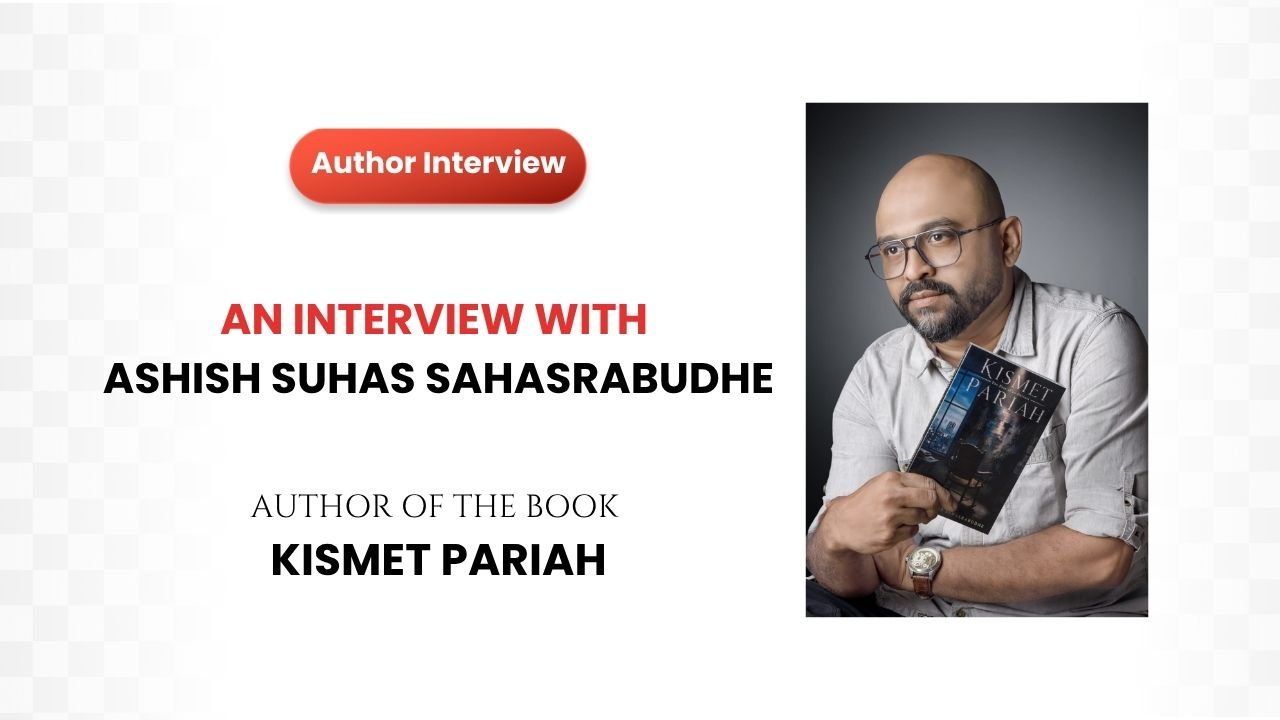
Today’s guest is Ashish Suhas Sahasrabudhe, a Mumbai-based banking IT professional whose second novel, Kismet Pariah, arrives nearly ten years after his first. It’s a crime novel set during the lockdown, moving between Pune, Solapur and Mumbai, and it’s as interested in how people hide as in how they are found. I finished it with a long list of questions, so let’s get straight to them.
Bobby George: Ashish, welcome, and congratulations. Let me begin with the gap. Nearly ten years separate your first novel from this one. What happened in those years, and what finally brought you back to the desk?
Ashish Suhas Sahasrabudhe: Ten years looks like a long gap, but I wasn’t idle. I was growing several manuscripts with the snowflake method, from a one-line idea to a full draft. Kismet Pariah was closest to my heart because it speaks to both the head and the heart, so I finished it first. Finding a traditional publisher, and funding the publishing and marketing myself, slowed things down. But this story deserved to be told. If it makes readers look at a certain section of society with empathy, if not respect, the wait was worth it.
Bobby George: Kismet Pariah is an unusual pairing of words, one about fate and the other about exclusion. Without giving anything away, when did the title arrive? Was it there from the first page, or did the book earn it later?
Ashish Suhas Sahasrabudhe: It was there from the very first line of my outline, and the whole manuscript grew around it. After all, every person tagged a ‘Pariah’ for no fault of his needs a good ‘Kismet’ to help him fight through life.
Bobby George: Much of the novel unfolds in Solapur, a mill town that rarely appears in crime fiction. I’ve never been there, but after reading the book I felt I could find my way around. Why Solapur, and what is your own connection to it?
Ashish Suhas Sahasrabudhe: The twist in the tale comes from a real conversation with a local, though it had nothing to do with this book at the time. Solapur is close to my heart because my family is devoted to the Akkalkot Swami, and our frequent visits to the temple have left a lasting mark on us. The places in the novel are not exact, but they come from what I observed on those trips.
Bobby George: The gallery owner, Damania, says something chilling: a dead painter is worth more than a living one. You work in banking. Did your view of how the world puts a price on things shape the art-market side of the story?
Ashish Suhas Sahasrabudhe: Not banking, honestly. It is plain demand and supply. When a renowned painter cannot produce another canvas, what exists becomes finite, and I believe finite things rise in value. But every painting with a story escalates in value. After all, it is a story that can make a banana taped to a canvas priceless art. So a dead painter with a controversial end hands a story to every one of his works. Damania does not invent that cruelty. He just says out loud what the market quietly thinks.
Bobby George: Early on, we see a courtyard with a tulsi plant on one side and Arabic calligraphy on the other, a family living with two faiths under one roof. That is delicate territory to write about in India today. How careful did you have to be, and did you ever hesitate?
Ashish Suhas Sahasrabudhe: I did not hesitate, but I was careful. The book touches several sensitive subjects, and I wanted each one treated with warmth and dignity. Imagine a courtyard where you are the most important person, yet you lose all value the moment you step out of the four walls designed to respect your existence. It is the same feeling a middle-class employee knows in a toxic work culture, adjusting to the constant resentment and insults of peers and seniors. All you need to do is empathize with people, and you understand a lot of unspoken truths.
Bobby George: Inspector Khare is in his late forties, wears a watch his wife gave him years ago, and has twenty-six years of cases behind him. He isn’t the brooding loner or the flashy hero we usually get. What did you want him to be that fictional policemen often aren’t? Is he based on anyone?
Ashish Suhas Sahasrabudhe: Khare is not modelled on one person, though he carries traits of the quiet, dutiful officers I have known or heard about. I did not want a hero. A flashy detective would have pulled attention from what this story is really about: people and society. So Khare is an everyday man with a long career, a family, and a watch his wife gave him, doing his job as honestly as he can.
Bobby George: You write around a demanding day job. When does the writing actually happen, late at night or early in the morning? And at home, who reads your drafts first, and how honest are they with you?
Ashish Suhas Sahasrabudhe: Mostly late at night, around my day job. Late nights give you much-needed peace of mind when the world sleeps, and the universe offers a plethora of ideas around which a decent novel can be built. Kismet Pariah took over three years, so I was always expanding a skeleton I already had. My first reader is a school friend, RijuRaj, who is brutally honest with me. Then family and a few friends read the raw manuscript, and I have thanked them all in the acknowledgements.
Bobby George: Your author note says you keep a careful distance between what you show the world and what you keep to yourself. The painter at the centre of this book does the same. How much of Ashish is hidden in Kismet Pariah?
Ashish Suhas Sahasrabudhe: The painter’s life was always meant to be a mystery, and I like my own life a little misdirected too. The world offers sympathy or malice more readily than empathy, and sharing your troubles can multiply them. But if I must choose, I am most like Mukadam, with his constant desperation to reach home. If you are blessed with a good family, that is where you can finally stop pretending.
Bobby George: I’ll steer clear of spoilers here. Many crime novels tie up every thread in the final chapter, but this one makes a very deliberate choice about what goes into the official record. Was that ending always there, or did you arrive at it while writing?
Ashish Suhas Sahasrabudhe: The ending was fixed from the start, and it mattered because no person should have to go through an unnecessary ordeal just because the world does not understand his ‘normal’. It is about time we stopped dictating the definitions of normalcy. Beyond that, I will leave it to readers.
Bobby George: Finally, what advice would you give writers who, like you, have a full-time career and a story they can’t stop thinking about? And what are you working on next?
Ashish Suhas Sahasrabudhe: Your job puts bread on the table, so keep it. My advice sounds like a cliché, but small steps toward your goal work. A delayed project is always better than an unfinished one. As for what is next, all I will say is: ‘Ask the sky and hope it answers.’
Thank you, Ashish, for taking us behind the scenes of Kismet Pariah. It takes patience to write a book like this alongside a career, and it shows on every page. I wish you every success with it, and I hope the next one comes a little sooner.
Over to you, friends. If you’ve already read Kismet Pariah, I’d love to know which character stayed with you. If you haven’t, you now know a little more about the man who wrote it.
Stay tuned for the next interview with a new pen on another new day. Don’t forget to post your comments.
Until then, Ciao!
Bobby George