Title: Tears of Turbulence and Imprisonment
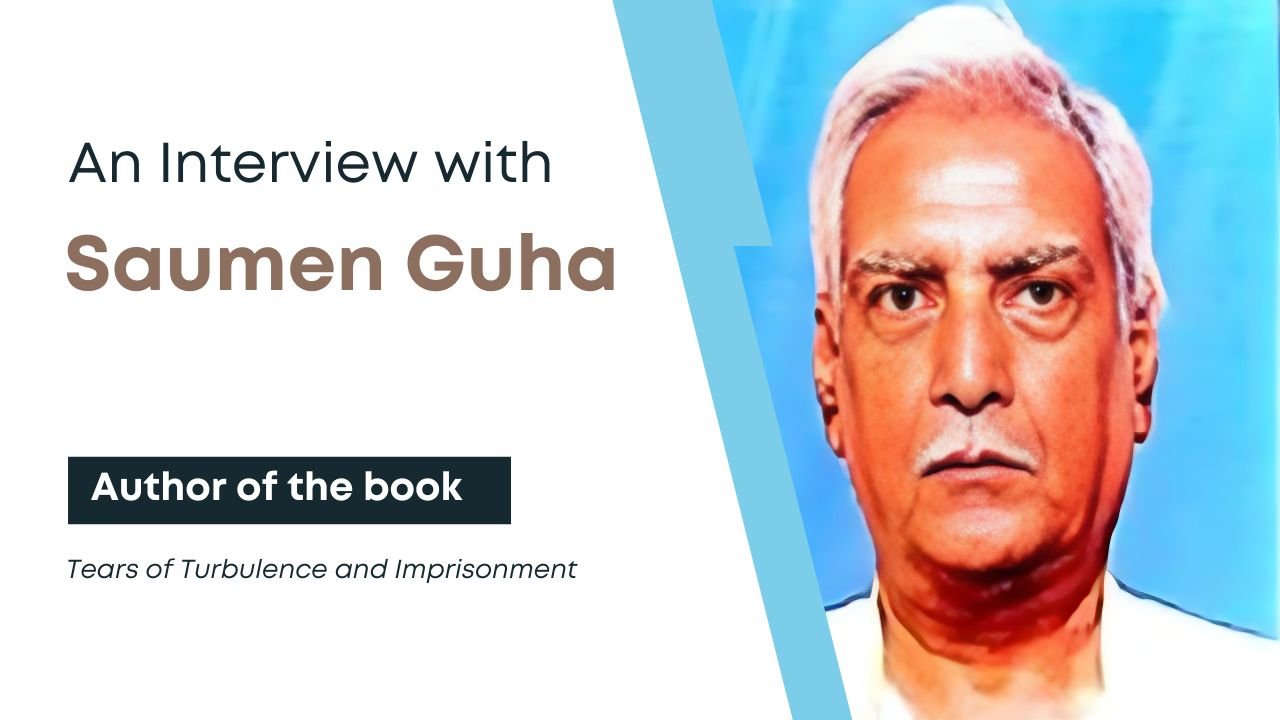
Author: Saumen Guha
ISBN: 9789373356594
Publisher: Evincepub Publishing
About the Book
The book consists of poems on various themes and feelings, and in addition English version of some older poems of the author with social, human and revolutionary context, and finally some poems written during imprisonment in 1970s.
About the Author
Saumen Guha was born in 1947 in East Pakistan (now Bangladesh), brought up as a poor refugee in West Bengal, and is now an Indian citizen.
Formally trained in science and engineering for his livelihood, he left his job as Engineering Overseer (Mechanical and Electrical) at the Calcutta Metropolitan Development Authority in 1970 to work with poor peasants in villages as a Communist revolutionary (called Naxalite).
Due to his involvement in militant Communist ideology, he and his family members, including his wife, were arrested and brutally tortured by the West Bengal and Calcutta police in 1974 and imprisoned for three years.
He is the architect of the internationally famous and historic ‘Archana Guha Case’ against torture in police custody, one of the world’s longest legal battles, and continues the crusade as counsel for the prosecution toward victory.
He is a devoted reader, writer, painter, and music lover. He has written and edited several books and authored many articles on human rights, music, films, literary biography, socio-economics, nuclear pollution, and related subjects.
Saumen is now busy preparing the English version of his memoir of imprisonment, Bright Darkness, and a compilation of documents related to the ‘Archana Guha Case’ against torture in police custody.
Deep in the Broken Words is the first book of English poems by Saumen Guha. Tears of Turbulence and Imprisonment is his second book of English poems.
Neel Preet: What inspired you to write Tears of Turbulence and Imprisonment?
Saumen Guha: The poems I wrote amid the various storms of my life reflect my emotions. The emotions I experienced during those turbulent times felt like mere teardrops falling. Now, in my old age, I feel moved to gather them and share them with others.
Neel Preet: How did you choose the poems that are included in this collection?
Saumen Guha: I selected the poems for this book to bring together the various forms of inner anguish or pain that often linger within, while also expressing the experiences gained from a life in politics.
Neel Preet: The book covers many emotions and themes. Which theme is closest to your heart?
Saumen Guha: Life has taught me since childhood to view people simply as human beings, and I cherish that humanitarian perspective above all else. My main goal is to understand, voice, and express the world’s suffering and pain.
Neel Preet: How different was it to write poetry in English compared to your earlier works?
Saumen Guha: This differs slightly from the earlier poems in that it expresses the agonies of life more clearly and openly – agonies that are deeply intertwined with my own experiences.
Neel Preet: What message would you like readers to take from this book?
Saumen Guha: To the readers of these poems, I simply wish to convey that just as life holds sorrow, suffering, and pain, there also resides within us an inner strength for the struggle – a strength that must be expressed outwardly. And eventually, that very strength becomes the inspiration to love others simply for being human.
Neel Preet: Some poems are based on real experiences. How important is personal experience in your writing?
Saumen Guha: All the experiences of my life form the foundation of my thinking, and by looking towards them, I move forward; time and again, these experiences have helped me advance and have given me strength.
Neel Preet: How has your poetry changed over the years?
Saumen Guha: As I have aged, I have grown more mature in evaluating my past thoughts and actions; that process of evaluation has provided the substance and purpose for my poetry – a significant achievement at this stage of my life.
Neel Preet: Was there any poem in this collection that was especially difficult to write?
Saumen Guha: The most agonising part was writing poetry while confined inside the prison – and it wasn’t merely due to the lack of materials. The greatest torment lay in the anguish of that very moment – looking back at the past and ahead to the future – an agony that simply could not be expressed in words; that was the hardest part of all.
Neel Preet: What role do memories play in your poems?
Saumen Guha: I have always felt that every poem is born from the depths of one’s own memories – and if those memories are filled with diverse experiences, the poem transforms into a unique saga. I prefer to write poetry rooted in reality rather than relying on imagination that transcends my own experiences.
Neel Preet: How do you balance personal feelings with social concerns in your poetry?
Saumen Guha: Society has shaped my entire life, from childhood to adulthood; there is no disconnect between my thoughts and society – on the contrary, my own way of thinking has evolved in tandem with it. I perceive society as a vast world, one teeming with countless… I have witnessed firsthand – and know directly – that they live with ceaseless suffering; to me, those scenes are as vivid as a moving picture. I have always felt that there is nothing I can do for them.
Neel Preet: Which poem in the book means the most to you and why?
Saumen Guha: During my imprisonment, I truly felt as though I was losing my mind – that I was going mad; yet, that single pencil and the paper I had so painstakingly procured were what kept me alive amidst that torment. That is why I recall those extraordinary times so vividly, and the words that conveyed it all.
Neel Preet: What challenges did you face while preparing this collection?
Saumen Guha: The dilemma of which poems to include and which to leave out never troubled me, because I felt that – regardless of my views on love, romance, or my life’s purpose – I would never find common ground with the genteel society around me; thus, I focused on my own goals and reflections.
Neel Preet: How do you hope younger readers will connect with your poems?
Saumen Guha: Young men and women are the ones who should find the poems in this book most compelling; after all, I have written about experiences they have not yet lived through. Thus, the true readers are those who discover within these poems a certain truth – a truth that resonates with their own imaginations.
Neel Preet: What does poetry mean to you personally?
Saumen Guha: Lying myself bare before everyone – emphasizing a critical moment between life and death – was precisely what I desired.
Neel Preet: Why do you think poetry remains important in today’s world?
Saumen Guha: Looking at the world, I see that the level of suffering only continues to rise; thus, I feel compelled to share a few words with people – words that capture every single moment of a life once spent dreaming.