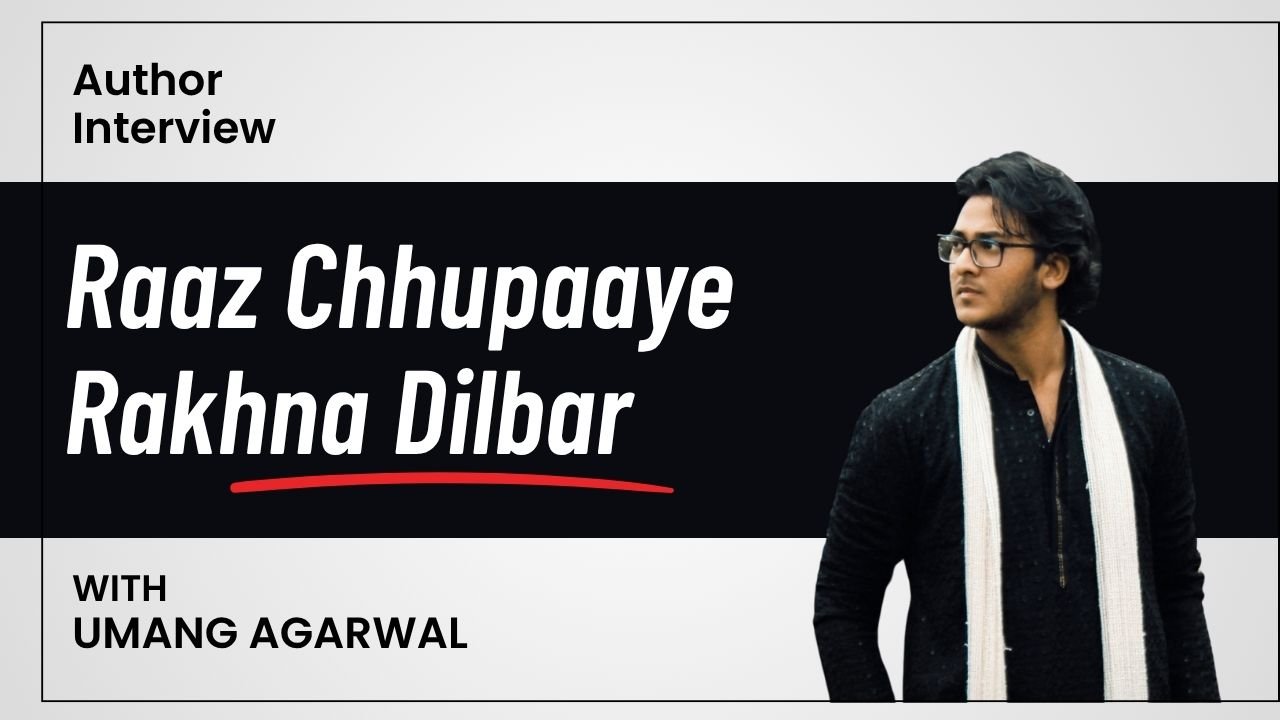
Title: Raaz Chhupaaye Rakhna Dilbar
Author: UMANG AGARWAL
ISBN: 9789373357829
Publisher: Evincepub Publishing
About the Book
“A Peaceful Sanctuary for Restless Dreamers”
Across 4 evocative segments; Raina, Dashamlav, Jheeni, and Aagaaz; this collection weaves together 50 Shers, Nazms, Ghazals, and Poems that capture the emotional landscape of modern youth. Written with a rare blend of simplicity and depth, the pieces sit beside the reader as a gentle companion through heartbreak, longing, and hope. To ensure the beauty of the verse is accessible to all, the book features clear explanations for difficult words and thoughtful transliteration, allowing the reader to experience the poetry in the language that resonates most with them. It also features a special chapter dedicated to the author’s debut song, ‘Reshmi’; including unreleased lyrics; and a curated ‘Mood Playlist’ to set the tone for the journey. By balancing raw honesty with artistic flair, the book provides high value for both time and heart, making it a rare keepsake for any reader, an invitation to own a piece of art that understands one’s unspoken truths and transforms them into a lasting companion.
About the Author
Umang Agarwal is a 23 y/o author from Kolkata. He is a Film & Music Director, Composer, Lyricist, Vocalist and Poet. He is also the Founder-Director of Mrigtrishna Productions Pvt. Ltd., a Film & Music Production company, with song releases available on:
Streaming Platforms: Spotify | YouTube | YouTube Music | JioSaavn | Apple Music | Amazon Prime Music
Social Media: Instagram | Facebook | LinkedIn | X (Twitter)
Neel Preet: What was the first poem you wrote for this book and what inspired it?
Umang Agarwal: “Dil har lamha tang hai, waqt waqt ki baat nahi,
Har pal katna mushkil hai, tu jo mere saath nahi!”
– Chapter III (Jheeni) Page No. 103-104
Written on 12th April, 2021. As far as inspiration is concerned, details are not important – but I can say that the sher itself tells its origin story.
Neel Preet: How did your personal life experiences shape the emotions in this book?
Umang Agarwal: They say that the nights belong to the artists. My songs come during the day, and my poetry during the night. I had never thought about this until this very moment, and I have absolutely no clue why such a differentiation exists, it’s fascinating. I write what I feel, I feel what I experience, and therefore all my writings are in some way connected to my personal experiences. Readers can verify this from the thought process behind my writing style, as has been demonstrated in Chapter IV.
Neel Preet: Did you ever feel stuck while writing? How did you overcome it?
Umang Agarwal: While ‘Writer’s Block’ is a common situation, I handle it by acknowledging the lack of ideas. I remember I was writing a sher once and I couldn’t figure out the ending for it, so I wrote:
“Likhte likhte mann mein aaya,
Chhod do, bas chhod do…!”
I got so many compliments for it by people despite it being such – it reinforced my belief in honest writing.
Neel Preet: How do you decide when a poem is complete?
Umang Agarwal: It’s all through the heart! The beats of my heart form the commas and full stops, in my pieces. I don’t usually take long to complete a sher, I feel the essence gets lost if I overthink my poetry – especially when they have no commercial or audience-pleasing motive, which is basically the case all the time. A thought comes to me, usually before I go to sleep, and I write it down. I write till I feel my thought has been conveyed or answered duly, and once the last stanza (or the last line) feels like a good end, I let the piece be!
Neel Preet: What role does silence play in your writing process?
Umang Agarwal: I don’t know if I talk more than I stay silent – my friends would know that better, I’m sure – but I do know that every sher of mine is a product of all the moments when I had something to say but chose to (or had to) stay silent. I remember watching a video where our former Prime Minister, Shri Dr. Manmohan Singh Ji, was asked about his soft-spoken & silent demeanour – and he beautifully replied by reciting this couplet –
“Hazaaron jawaabon se achchi hai meri khaamoshi,
Na jaane kitne sawaalon ki aabroo rakkhe…”
Neel Preet: Do you write more from memory or from imagination?
Umang Agarwal: Memories are painful, imaginations are futile. I write from my feelings – rest is a never-ending war between the heart and hindsight. Neither does one lose, nor does another win!
Neel Preet: Which emotion was the most difficult for you to express in this book?
Umang Agarwal: Contentment. It’s easier (for me) to exaggerate unrest, than to even fathom peace.
Neel Preet: How do you handle criticism or different interpretations of your poetry?
Umang Agarwal: I yearn for both! While criticism helps me stay grounded, varied interpretations help me widen my gaze, beyond the horizons my mind can reach. Once I was shooting a music video for a song, with a very dear friend of mine, a senior – Priyansh Bhaiya – and while we drove to the shoot location, he was telling me how he prepped for the song the previous night. He told me how he broke each line down, and while he was explaining the lines to me, I realised that his interpretation of the very opening line is poles apart from its intended meaning – but both are correct without any scope of debate. That day I realised the beauty in interpretation, which get lost in translations most of the time – and that is one of the reasons I was particular about not translating my poetry in the book, and restricted myself to transliterations.
Neel Preet: Did you follow a routine while writing or was it spontaneous?
Umang Agarwal: I hate routines. I thrive on spontaneity. I guess this holds true for most artists – I may be wrong.
Neel Preet: How important is storytelling in your poetry?
Umang Agarwal: I don’t rely on stories to convey a message, although as an aspiring film-maker, I do know the value of stories and realise the power of storytelling in driving human consciousness. I sometimes try to depict a narrative through my poetry, but it always, ALWAYS – ends up being a song, more than a poetic piece. One of my songs ‘Sitaara’ (unreleased) is an example of it, and so is Reshmi.
Neel Preet: What kind of reader reactions do you expect from this book?
Umang Agarwal: Honestly, I just hope and pray that people read the book – be it any reaction that I may get. I’ll be happy to hear complaints (fingers crossed) from invested readers rather than praises from those who haven’t touched a page. And if you are reading this and do decide to read the book – read every page and let me know how it worked for you!
Neel Preet: How do you balance simplicity and depth in your writing?
Umang Agarwal: Still waters run deep. I don’t try to balance anything. The puzzles arrange themselves. If I write something simple, I usually find it to be deeper than the more verbose ones. There is no technique or thought process to balance parameters of my poetry, I just let them be. They find their audience, sooner or later – and I am thankful for this.
Neel Preet: Did any real person inspire specific poems in the book?
Umang Agarwal: The book’s title is probably the best answer to this question, (laughs).
Neel Preet: What did writing this book teach you about yourself?
Umang Agarwal: It taught me more about people than it did about me. I think I know myself, and that stands true most of the time. But people, I thought I knew them. Turns out I have absolutely no idea how unpredictable they can be, and this lesson, I shall cherish – in both good and not-so-good terms!
Neel Preet: If you had to describe your book in one feeling, what would it be?
Umang Agarwal: “Kasak” (a sweet pain)